
Before Indra Jatra Begins: Basantapur Prepares for Kathmandu’s Living Heritage
Where the festival begins before the crowds arrive
Before the streets of Kathmandu fill with music, processions, devotees, and celebration, Indra Jatra begins in quieter moments.
In Basantapur, preparations unfold among centuries-old temples, courtyards and historic buildings. Ceremonial structures are cleaned, ropes are arranged, sacred objects receive offerings, and people work carefully to prepare the heart of Kathmandu for one of its most important traditional festivals.
These moments are easy to miss once the celebration begins, yet they reveal another side of Indra Jatra the dedication required to keep a living tradition alive.
The sacred Yosin and the beginning of anticipation
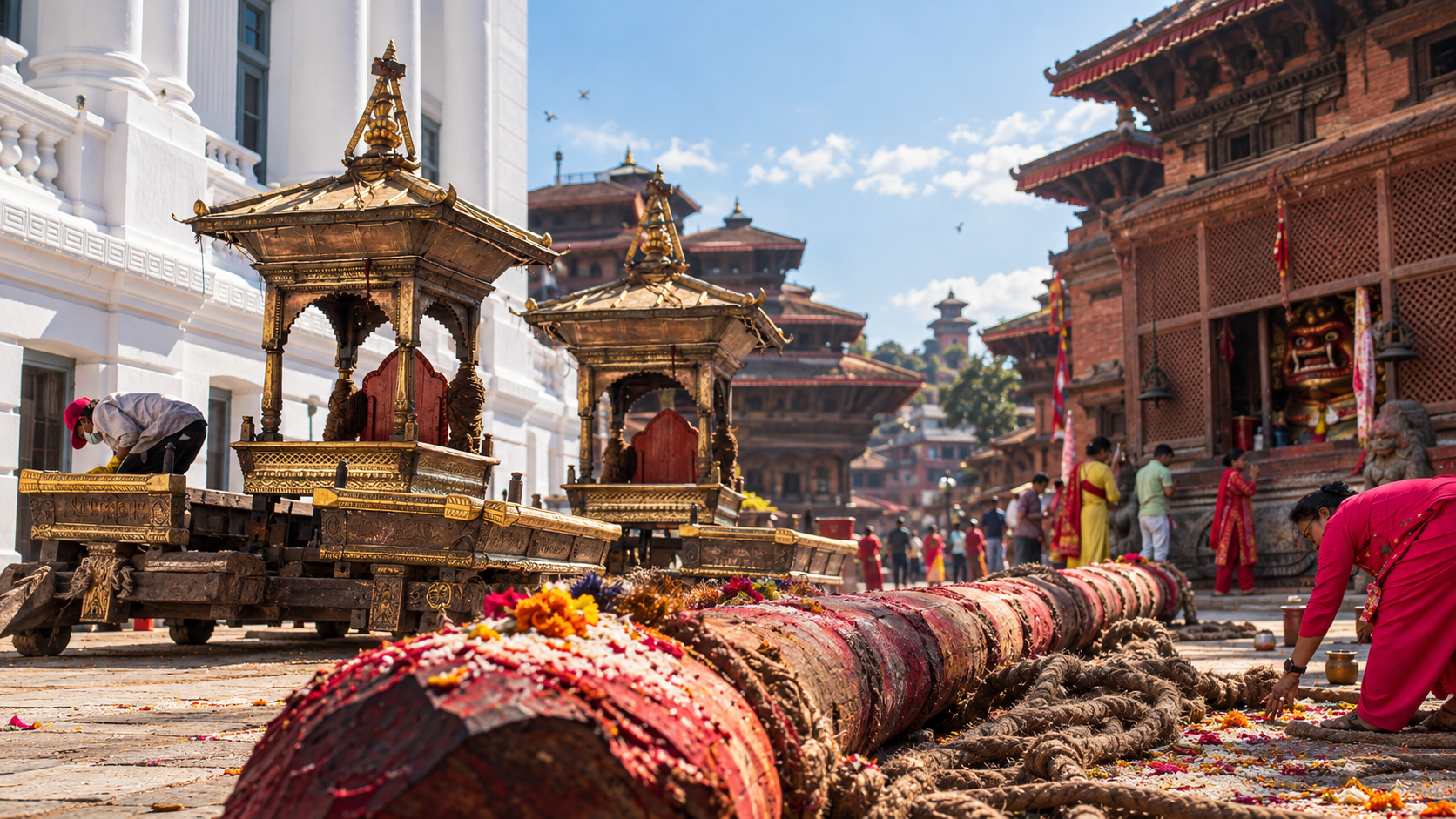
One of the most striking sights during the preparations is the great wooden Yosin, covered with vermilion, ritual colours, flowers and offerings.
Lying across the stone-paved square with heavy ropes beside it, the pole immediately commands attention. It is not simply a piece of timber being prepared for an event. Its presence signals that Basantapur is entering festival time.
Marigolds, rice, coloured powders and other offerings transform the wood into something deeply connected with ritual and collective memory.
Even before it is raised, the Yosin becomes a gathering point where devotion, preparation and anticipation meet.
Craftsmanship that carries tradition
Nearby, beautifully decorated ceremonial structures stand against the contrasting architecture of Basantapur.
Their golden surfaces, carved columns, traditional roofs and red interiors reflect generations of Nepali craftsmanship. Up close, every section reveals another detail patterns hammered into metal, carefully shaped arches, aged wooden elements and marks left by years of use.
But these structures do not exist merely to be admired.
People can be seen cleaning, inspecting and preparing them for the festival. It is physical, patient work carried out before thousands of visitors eventually witness the celebrations.
This is where heritage becomes more than architecture.
It becomes something people actively maintain.
Basantapur: where different eras of Kathmandu meet
The surroundings make these preparations even more visually powerful.
On one side stand bright white historic façades. On another rise the carved windows, brick walls and tiered roofs associated with the traditional architecture of Kathmandu.
Between them sit ceremonial structures that have their own histories.
The result is a landscape where different periods of Kathmandu coexist within a few steps of one another.
During Indra Jatra, these streets and squares become more than a historic setting. They become a living stage where ritual, community, architecture and memory come together.
The people behind the festival
Large festivals are often remembered through their biggest moments the crowds, chariot processions, music and public ceremonies.
But traditions survive because of the quieter work that comes first.
Someone cleans a ceremonial platform.
Someone arranges flowers.
Someone prepares an offering.
Someone handles the ropes.
Someone makes sure an object used for generations is ready to take its place once again.
These actions may appear ordinary individually, but together they are what allow a centuries-old celebration to continue in modern Kathmandu.
Indra Jatra therefore belongs not only to history books or photographs.
It belongs to the people who continue to perform it.
A living heritage, not a museum piece
Basantapur is often introduced through phrases such as historic Kathmandu or ancient Durbar Square. Those descriptions are accurate, but they tell only part of the story.
Places like Basantapur remain significant because traditions continue to happen here.
Temples are still visited.
Bells are still rung.
Offerings are still made.
Festivals still transform the squares.
And younger generations continue to encounter traditions that were practised long before the modern city grew around them.
Indra Jatra demonstrates that heritage does not have to remain frozen in the past.
Here, heritage moves.
It is prepared, carried, worshipped, celebrated and passed forward.
Before celebration comes preparation
Soon, the quiet scenes of preparation will give way to the energy for which Indra Jatra is famous.
The squares will become crowded. Processions will move through old Kathmandu. Music will echo through narrow streets, and thousands of people will gather around Basantapur.
But before all of that comes this moment.
The chariots waiting.
The sacred pole resting on the stones.
Flowers scattered across the ground.
Hands carefully preparing objects whose significance reaches far beyond the festival itself.
Perhaps this is where the real story of Indra Jatra begins not when the celebration reaches its loudest point, but when Kathmandu quietly begins preparing to remember, honour and continue its traditions once again.